The Research and Postgraduate Centre congratulates Assoc. Prof. Dr. Song Kok Wee from the Department of Physics, for the recent research article published in Physical Review Letters, an SCIE Q1 journal with the latest impact factor of 9.1.
This research is conducted in collaboration with Prof. Dr. Oleksandr Kyriienko from the University of Sheffield.
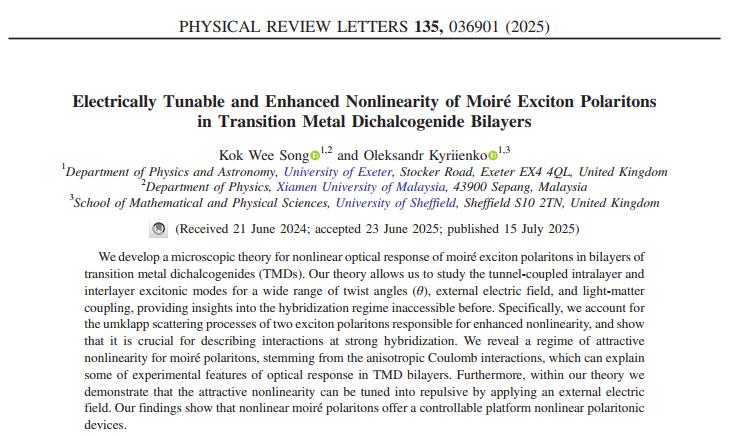
The article, titled “Electrically Tunable and Enhanced Nonlinearity of Moiré Exciton Polaritons in Transition Metal Dichalcogenide Bilayers”, presents a new microscopic theory revealing how light–matter interactions in twisted two-dimensional materials can be significantly enhanced and electrically controlled.
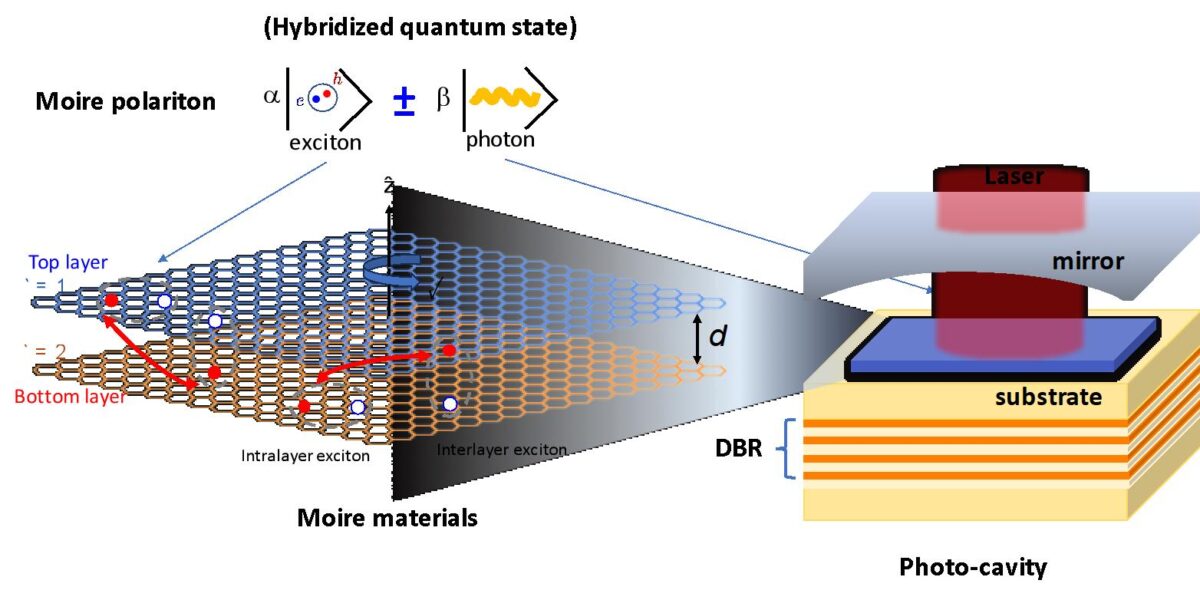
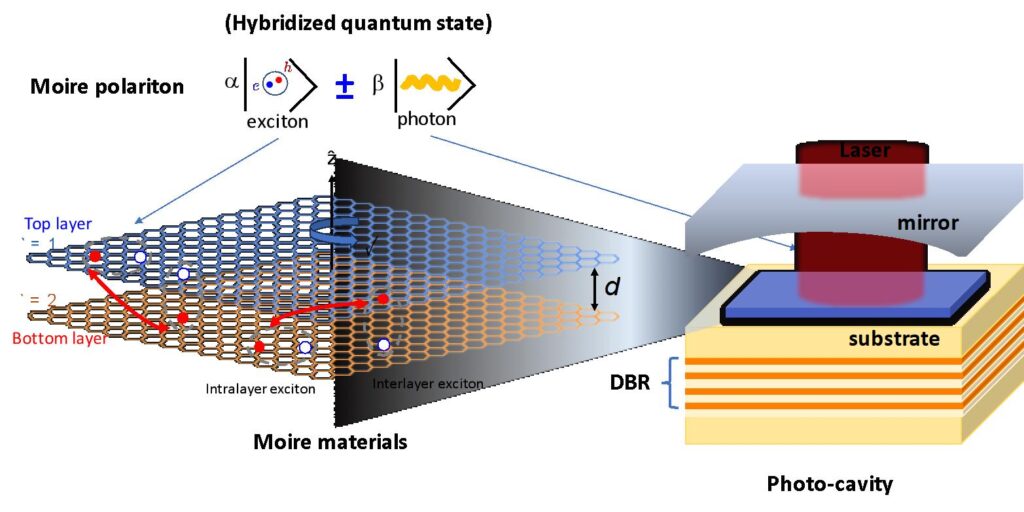
The research focuses on a special type of hybrid particle known as moiré exciton polaritons, which emerge when ultra-thin materials are slightly twisted and placed inside an optical cavity. This small rotational misalignment creates unique patterns that dramatically alter the materials’ optical properties.
One of the key findings is that the interactions between these particles can be switched from attractive to repulsive through the application of an external electric field. Such tunability is rare in excitonic systems and provides new possibilities for developing flexible nonlinear photonic devices and exploring quantum phenomena.
Overall, the work highlights moiré polaritons as a promising and controllable platform for future applications in quantum optics and photonic engineering.
The project received financial support from UK EPSRC Awards No. EP/X017222/1 and Xiamen University Malaysia Research Fund (Grant No. XMUMRF/2025-C15/IPHY/0005).
Assoc. Prof. Dr. Song Kok Wee is a theoretical physicist specializing in condensed matter physics and quantum optics, with a focus on two-dimensional materials, strongly correlated quantum systems, superconductivity, and light–matter interactions. He received his PhD from the University of Southern California, United States. Prior to joining Xiamen University Malaysia, Dr. Song held research positions at the University of Exeter, England, the National Graphene Institute, England and Argonne National Laboratory, United States.